
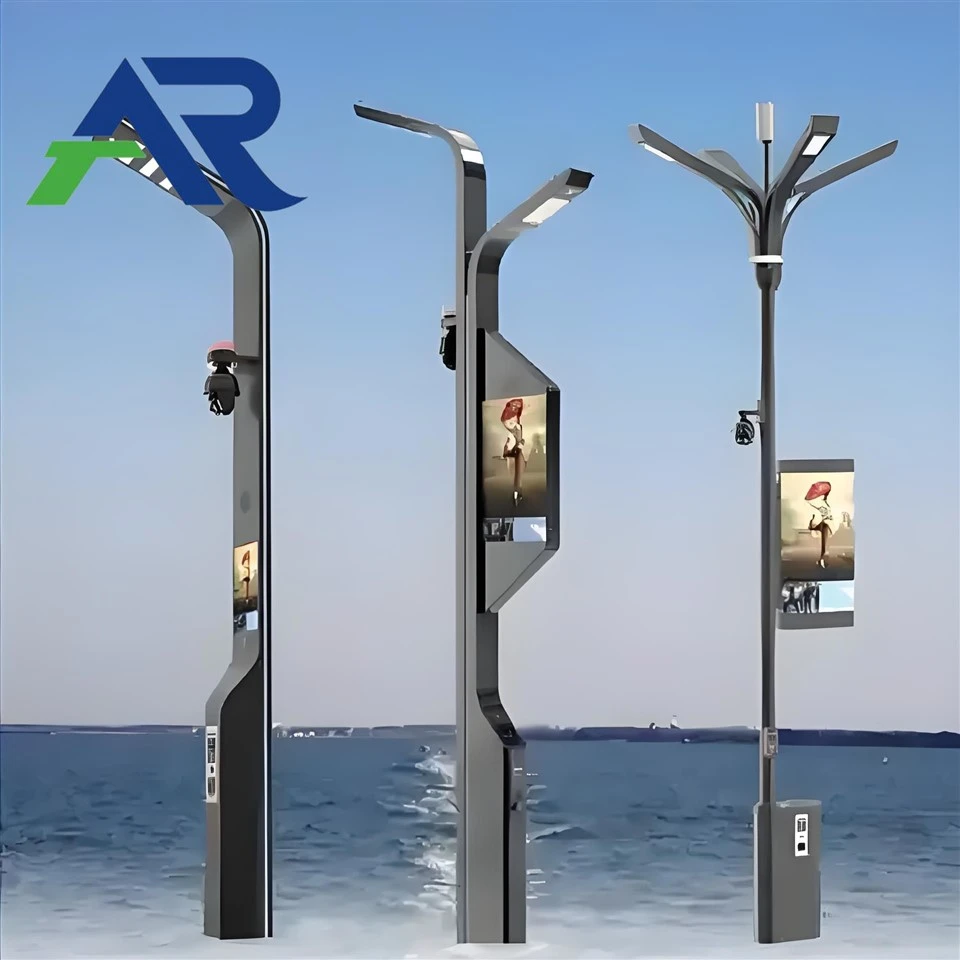
In the era of rapid technological advancement, smart cities are emerging as the future of urban development. At the heart of this transformation are smart infrastructure components, among which the Smart Light Pole stands out as a multi - functional and innovative solution. As a leading Smart Light Pole supplier, I am excited to delve into the various types of sensors used in these intelligent poles and their significance in enhancing urban life.
Environmental Sensors
Air Quality Sensors
Air quality is a critical aspect of urban living. Smart Light Poles equipped with air quality sensors can continuously monitor pollutants such as particulate matter (PM2.5 and PM10), carbon monoxide (CO), sulfur dioxide (SO₂), and nitrogen dioxide (NO₂). These sensors use advanced technologies like electrochemical cells or optical scattering to detect and measure the concentration of pollutants.
For example, electrochemical sensors work by reacting with the target gas, generating an electrical current proportional to the gas concentration. The data collected by these sensors is then transmitted to a central monitoring system. City planners can use this information to identify pollution hotspots, implement targeted environmental policies, and inform the public about air quality conditions. This not only helps in improving public health but also contributes to sustainable urban development.
Weather Sensors
Weather sensors in Smart Light Poles are essential for providing real - time weather data. They can measure parameters such as temperature, humidity, wind speed, and precipitation. For instance, a thermistor is commonly used to measure temperature, while a capacitive humidity sensor can accurately detect the moisture content in the air.
Wind speed can be measured using an anemometer, and precipitation can be detected by a rain gauge. This data is invaluable for various applications, including traffic management, energy optimization, and emergency preparedness. For example, if strong winds are detected, traffic authorities can issue warnings to drivers, and the Smart Light Pole's lighting system can be adjusted to ensure better visibility.
Traffic Sensors
Vehicle Detection Sensors
Vehicle detection sensors play a crucial role in traffic management. There are several types of vehicle detection sensors used in Smart Light Poles, such as inductive loop sensors, microwave sensors, and infrared sensors. Inductive loop sensors work by detecting changes in the magnetic field caused by the presence of a vehicle. These sensors are buried in the road surface near the Smart Light Pole.
Microwave sensors, on the other hand, emit microwave signals and measure the reflected signals to detect the presence, speed, and direction of vehicles. Infrared sensors detect the heat signature of vehicles. The data collected by these sensors can be used to adjust traffic signal timings in real - time, reducing traffic congestion and improving the overall efficiency of the transportation system. You can learn more about Traffic Signal Pole Types on our website.
Pedestrian Detection Sensors
Pedestrian detection sensors are designed to detect the presence and movement of pedestrians. Ultrasonic sensors are commonly used for this purpose. They emit ultrasonic waves and measure the time it takes for the waves to bounce back from an object. This allows them to detect the distance and movement of pedestrians.
In addition, infrared sensors can also be used to detect the heat emitted by pedestrians. The data from these sensors can be used to improve pedestrian safety. For example, traffic signals can be adjusted to give pedestrians more time to cross the road when a large number of pedestrians are detected.
Lighting Sensors
Ambient Light Sensors
Ambient light sensors are used to adjust the brightness of the Smart Light Pole's lighting system based on the surrounding light conditions. These sensors typically use photodiodes or phototransistors to measure the intensity of ambient light.
During the day, when there is sufficient natural light, the sensors can reduce the brightness of the lights, saving energy. At night or in low - light conditions, the sensors can increase the brightness to ensure proper illumination. This not only saves energy but also extends the lifespan of the lighting fixtures.
Occupancy Sensors
Occupancy sensors are used to detect the presence of people in the vicinity of the Smart Light Pole. They can be based on infrared, ultrasonic, or microwave technology. When no one is detected in the area, the lighting can be dimmed or turned off, further reducing energy consumption.
Once a person enters the detection range, the lights can automatically turn on and adjust to the appropriate brightness. This feature is particularly useful in areas with low foot traffic, such as parking lots or alleys.
Security Sensors
Video Surveillance Cameras
Video surveillance cameras are an important security feature in Smart Light Poles. They can capture high - resolution video footage of the surrounding area, providing real - time monitoring and evidence in case of security incidents. These cameras are equipped with advanced features such as night vision, pan - tilt - zoom capabilities, and motion detection.
The video data can be stored locally or transmitted to a central security monitoring center. This helps in deterring criminal activities, enhancing public safety, and assisting law enforcement agencies in investigations.
Sound Sensors
Sound sensors can detect abnormal sounds such as gunshots, screams, or breaking glass. They use microphones to pick up sound waves and analyze the frequency and intensity of the sounds. When an abnormal sound is detected, an alert can be sent to the relevant authorities, enabling a quick response to potential security threats.
Communication and Connectivity Sensors
Wi - Fi and Bluetooth Sensors
Smart Light Poles can be equipped with Wi - Fi and Bluetooth sensors to provide wireless connectivity in urban areas. These sensors can create a local wireless network, allowing people to connect their devices to the internet. This is particularly useful in public spaces such as parks, sidewalks, and shopping areas.
The Wi - Fi and Bluetooth sensors can also be used for location - based services, such as providing information about nearby attractions or promotions. In addition, they can be used for data collection, such as analyzing the movement patterns of people in the area.
LoRaWAN Sensors
LoRaWAN (Long Range Wide Area Network) sensors are used for long - range, low - power communication. They are ideal for transmitting sensor data over long distances with minimal power consumption. These sensors can be used to connect all the other sensors in the Smart Light Pole to a central network, enabling seamless data transfer and management.
As a Smart Light Pole supplier, we understand the importance of these sensors in creating a more intelligent, sustainable, and secure urban environment. Our Smart Light Poles are designed to integrate these sensors effectively, providing a comprehensive solution for smart cities. If you are interested in our Smart Light Pole products, or if you have any questions about the sensors and their applications, we invite you to contact us for a procurement discussion. Our team of experts is ready to assist you in finding the best solution for your specific needs. Whether you are a city planner, a traffic management authority, or a security professional, our Smart Light Poles can be customized to meet your requirements.
References
- "Smart City Technology: A Comprehensive Guide" by John Doe, 2020
- "Sensor Technology Handbook" by Jane Smith, 2019
- "Urban Infrastructure and Smart Solutions" by Robert Johnson, 2021