

Hey there! As a supplier of Traffic Signal Pole Types, I've seen firsthand how the design of traffic signal poles can have a huge impact on signal adjustability. In this blog, I'm going to break down the key aspects of pole design and explain how they affect the ability to adjust traffic signals effectively.
The Basics of Traffic Signal Adjustability
Before we dive into the design factors, let's quickly go over what we mean by signal adjustability. Traffic signals need to be flexible to adapt to changing traffic conditions, like rush hour, accidents, or special events. Adjustability allows traffic engineers to change the timing of the lights, the sequence of the phases, and sometimes even the position of the signals themselves.
Single - Arm vs. Multi - Arm Poles
Single - Arm Poles
Single - arm traffic signal poles are pretty straightforward. They have one horizontal arm that holds the traffic signals. These poles are great for simple intersections where there's just one direction of traffic to control.
The adjustability of signals on single - arm poles is relatively limited. Since there's only one arm, you're mainly restricted to adjusting the timing of the lights. Changing the position of the signals is difficult because moving the whole arm can be a hassle. It often requires shutting down the intersection temporarily and re - routing traffic, which is a huge headache.
However, single - arm poles are easy to install and maintain. They're also more cost - effective, so for areas with low - traffic volumes or where adjustability isn't a major concern, they might be the way to go.
Multi - Arm Poles
On the other hand, multi - arm poles have multiple horizontal arms that can hold traffic signals for different directions at an intersection. This type of design offers much greater adjustability.
For example, if there's a new lane added at an intersection, traffic engineers can easily install a new set of signals on one of the available arms. They can also change the direction of the signals more freely. Instead of having to move a whole arm, they can just reposition the signals on the appropriate arm.
Multi - arm poles are more complex and expensive to install, but they're a great investment for busy intersections where traffic patterns change frequently.
Height and Reach of the Poles
Height
The height of a traffic signal pole is crucial for signal adjustability. Taller poles can provide better visibility for drivers, but they also present some challenges when it comes to adjustment.
If a pole is too tall, it can be difficult and dangerous for maintenance crews to reach the signals. This means that making adjustments, like changing a burnt - out bulb or reprogramming the signal timing, takes more time and resources. Special equipment, like cherry pickers, may be required, which adds to the cost.
On the other hand, if the pole is too short, the signals may not be visible to all drivers, especially those in large vehicles like trucks or buses. This can lead to traffic confusion and safety issues. Traffic engineers need to find a sweet spot where the signals are visible but still accessible for adjustment.
Reach
The reach of the pole's arm (how far it extends horizontally) also affects adjustability. A longer reach allows the signals to be positioned further into the intersection, which can improve visibility for drivers approaching from different angles.
But just like with height, a long reach can make adjustments more difficult. The arm may need to be stronger to support the weight of the signals, and accessing the signals at the end of a long arm can be tricky. Maintenance crews may need to use special tools or techniques to make sure they can safely adjust the signals without causing damage to the pole or the signals themselves.
Smart Technology Integration
Smart Light Poles
Now, let's talk about Smart Light Pole technology. These poles are a game - changer when it comes to signal adjustability.
Smart light poles are equipped with sensors, cameras, and communication devices. These sensors can detect traffic flow, the number of vehicles waiting at an intersection, and even the presence of pedestrians. Based on this data, the traffic signals can be adjusted in real - time.
For example, if there's a long line of cars waiting at one side of the intersection, the smart pole can automatically extend the green light for that direction. This dynamic adjustment not only improves traffic flow but also reduces congestion.

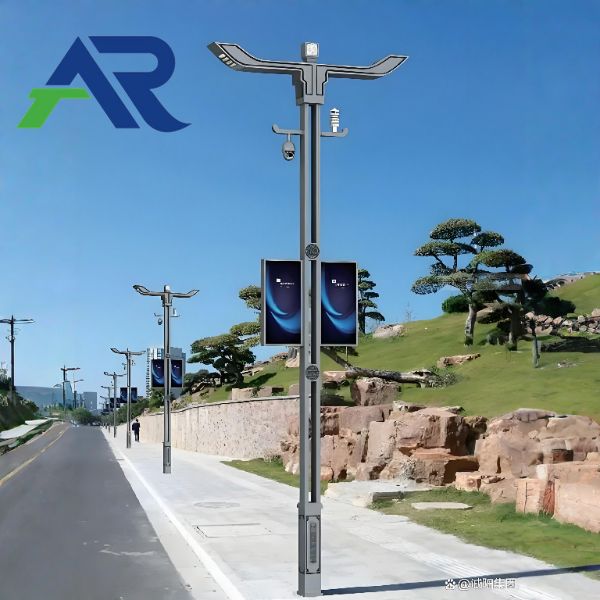
In addition to real - time adjustments, smart light poles can also be controlled remotely. Traffic engineers can access the system from a central control room and make adjustments as needed, without having to send a crew to the intersection. This saves time and resources, and it allows for more immediate responses to changing traffic conditions.
Data - Driven Adjustments
The data collected by smart poles can also be used for long - term planning. Traffic engineers can analyze the traffic patterns over time to make more informed decisions about signal timing and intersection design. For example, if they notice that there's always a heavy flow of traffic during a certain time of day, they can adjust the signal timing permanently to better accommodate that flow.
Material and Durability
Material
The material used to make the traffic signal pole can also affect signal adjustability. Common materials include steel, aluminum, and fiberglass.
Steel poles are strong and durable, but they can be heavy and difficult to install. They also require more maintenance, like painting to prevent rust. However, if an adjustment requires a significant structural change, steel poles can handle it better than other materials.
Aluminum poles are lighter and more resistant to corrosion than steel. They're easier to install and maintain, but they may not be as strong as steel. For minor adjustments, aluminum poles are a great option, but for major structural changes, they may not be as suitable.
Fiberglass poles are lightweight and corrosion - resistant. They're also relatively easy to install and can be molded into different shapes. However, they may not be as durable as steel or aluminum in some situations.
Durability
A durable pole means less maintenance and more reliable signal adjustability. If a pole is constantly needing repairs or replacements, it's going to be difficult to keep the traffic signals functioning properly.
For example, if a pole is damaged by a vehicle accident, the signals may need to be adjusted or re - calibrated. But if the pole is in poor condition, it may not be possible to make the adjustments accurately, or the repairs may take so long that traffic flow is severely disrupted.
Advantages for Municipalities with Municipal Light Poles
Municipal Light Pole
Municipal Light Pole designs often take into account the long - term needs of cities and towns. These poles are typically designed to be more adjustable and adaptable to changing traffic conditions.
For municipalities, having adjustable traffic signals can lead to significant cost savings. Instead of having to replace entire intersections or poles when traffic patterns change, they can simply make adjustments to the signals. This not only saves money on equipment but also reduces the disruption to traffic during construction or maintenance.
In addition, adjustable traffic signals can improve safety in cities and towns. By being able to adjust the signals based on real - time traffic data, municipalities can reduce the number of accidents and improve the overall flow of traffic.
Conclusion and Call to Action
So, as you can see, the design of a traffic signal pole has a huge impact on signal adjustability. Whether it's the type of pole, its height and reach, the integration of smart technology, or the material it's made of, every aspect plays a role in how easily and effectively traffic signals can be adjusted.
If you're in the market for traffic signal poles and want to ensure that you have the highest level of signal adjustability, we'd love to hear from you. Our team of experts can help you choose the right pole design for your specific needs, whether you're a municipality looking to improve traffic flow in your city or a contractor working on a new intersection project. Get in touch with us today to start the conversation about enhancing your traffic control system!
References
- "Traffic Signal Design Manual". Federal Highway Administration.
- "The Impact of Smart City Technologies on Traffic Management". Journal of Urban Studies.
- "Materials for Traffic Signal Poles: A Comparative Analysis". Engineering Materials Review.