

Electric power towers, often seen stretching across the landscape like silent giants, play a crucial role in the modern electricity transmission system. As a leading Electric Power Tower supplier, I am frequently asked about how these structures transmit electricity. In this blog post, I will delve into the science and engineering behind this process, shedding light on the intricate mechanisms that keep our lights on and industries running.
The Basics of Electricity Transmission
To understand how electric power towers transmit electricity, we first need to grasp the fundamentals of electricity itself. Electricity is the flow of electrons through a conductor, such as a wire. When a power plant generates electricity, it produces an electrical current that needs to be transported to consumers over long distances. This is where electric power towers come into play.
The electricity generated at power plants is typically produced at a relatively low voltage. However, for efficient long - distance transmission, the voltage needs to be increased. This is achieved through the use of transformers. Step - up transformers at the power plant increase the voltage of the generated electricity to very high levels, often in the range of hundreds of thousands of volts. High - voltage transmission is preferred because it reduces the amount of power loss during transmission. According to the power formula (P = VI), where (P) is power, (V) is voltage, and (I) is current, for a given amount of power (P), increasing the voltage (V) results in a decrease in the current (I). Since power loss in a conductor is given by (P_{loss}=I^{2}R) (where (R) is the resistance of the conductor), reducing the current significantly reduces the power loss.
The Role of Electric Power Towers
Electric power towers are the infrastructure that supports the high - voltage transmission lines. These towers are designed to withstand various environmental conditions, including wind, rain, snow, and extreme temperatures. They are typically made of steel or concrete, which provide the necessary strength and durability.
The transmission lines, which are usually made of aluminum or copper, are suspended from the towers using insulators. Insulators are crucial components that prevent the electrical current from flowing into the tower structure and the ground. They are made of materials such as porcelain, glass, or composite polymers, which have high electrical resistance.

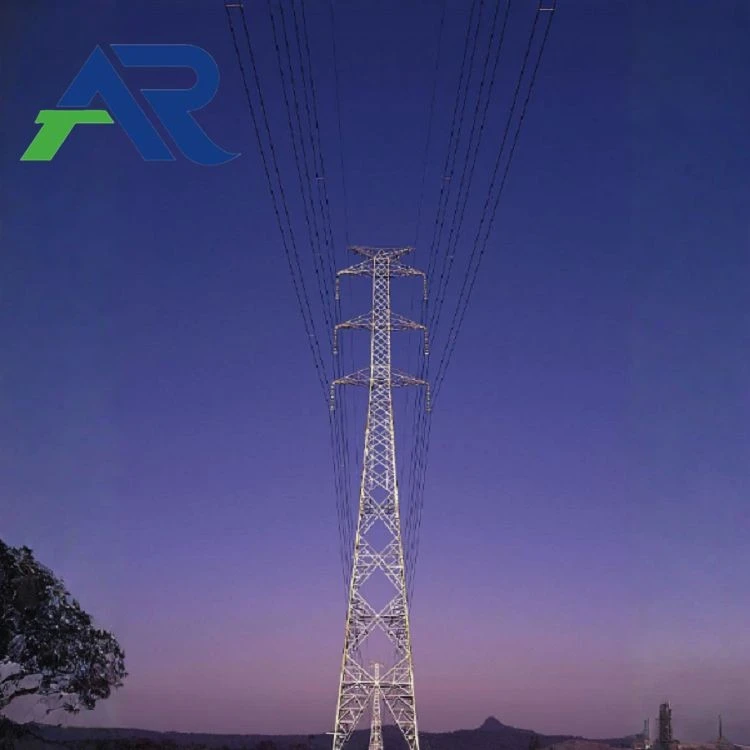
The layout of the power towers and transmission lines is carefully planned. The towers are placed at regular intervals along the transmission route. The distance between the towers depends on several factors, including the type of terrain, the voltage of the transmission line, and the weight of the conductors. In flat areas, the towers can be placed farther apart, while in mountainous or difficult terrain, the intervals may be shorter.
Different Types of Electric Power Towers
There are several types of electric power towers, each designed for specific purposes. Some of the common types include suspension towers, tension towers, and terminal towers.
Suspension towers are the most common type. They are used to support the transmission lines in a suspended position between two points. These towers are designed to withstand the vertical load of the conductors and the wind load. They are relatively simple in design and are used for long - span transmission lines.
Tension towers, on the other hand, are used to change the direction of the transmission line or to support the line at the end of a section. They are designed to withstand the horizontal tension forces in addition to the vertical and wind loads. Tension towers are more complex and stronger than suspension towers.
Terminal towers are located at the power plants or substations. They are used to connect the transmission lines to the power generation or distribution equipment. Terminal towers need to be able to handle high - voltage connections and are often equipped with additional safety features.
For more information on different types of industrial iron structures, you can visit our Industrial Iron Towers page. Our Iron Towers page also provides detailed information on the various iron tower products we offer.
The Transmission Process
Once the electricity has been stepped up to high voltage at the power plant, it enters the transmission lines supported by the electric power towers. The high - voltage electricity flows through the conductors, which are made of materials with low resistance to minimize power loss.
As the electricity travels along the transmission lines, it may encounter substations. Substations are important components of the electricity transmission system. At substations, the voltage of the electricity can be adjusted. Step - down transformers are used to reduce the voltage to a level that is suitable for distribution to consumers.
The transmission lines are connected to the substations through a series of switches and breakers. These switches and breakers are used to control the flow of electricity, isolate faulty sections of the line, and protect the equipment from over - current and over - voltage conditions.
Communication and Monitoring
In addition to transmitting electricity, modern electric power towers also play a role in communication and monitoring. Many power towers are equipped with communication devices that allow for real - time monitoring of the transmission lines. This includes monitoring the voltage, current, temperature, and other parameters of the lines.
The communication systems on the power towers can also be used for remote control of the switches and breakers at the substations. This enables operators to quickly respond to any issues or faults in the transmission system. For more information on communication tower building and related technologies, you can visit our Communication Tower Building page.
Challenges and Solutions in Electricity Transmission
There are several challenges in electricity transmission, and electric power towers need to be designed and maintained to overcome these challenges. One of the main challenges is the impact of environmental factors. Extreme weather conditions, such as hurricanes, ice storms, and earthquakes, can damage the power towers and transmission lines.
To address these challenges, power tower designs are constantly being improved. For example, towers are designed with aerodynamic shapes to reduce wind resistance. They are also built with stronger materials and more robust foundations to withstand seismic activity. Regular maintenance and inspection of the power towers are also essential to ensure their reliability.
Another challenge is the issue of electromagnetic fields (EMFs) generated by the high - voltage transmission lines. While there is still ongoing research on the potential health effects of EMFs, power companies take measures to minimize the exposure of the public. This includes proper siting of the transmission lines and the use of shielding technologies.
Why Choose Our Electric Power Towers
As a trusted Electric Power Tower supplier, we offer a wide range of high - quality power towers. Our towers are designed and manufactured to meet international standards and are built to withstand the most demanding environmental conditions.
We have a team of experienced engineers and technicians who are dedicated to providing the best solutions for our customers. Whether you need suspension towers for long - span transmission or terminal towers for power plant connections, we can customize our products to meet your specific requirements.
Our commitment to quality extends beyond the manufacturing process. We also provide comprehensive after - sales service, including installation guidance, maintenance support, and technical training.
If you are in the market for electric power towers, we invite you to contact us for a detailed discussion of your needs. Our sales team is ready to assist you in finding the right solution for your electricity transmission project.
References
- Grover, A. (2018). Electric Power Transmission and Distribution. McGraw - Hill Education.
- Stevenson, W. D. (2017). Elements of Power System Analysis. McGraw - Hill Education.
- Chapman, S. J. (2019). Electric Machinery Fundamentals. McGraw - Hill Education.